Russian soldiers were occupying Oma’s little apartment when we arrived, but they left when they understood that it was Oma’s home. They were also kindly left their food for us. After eating, we each took a bath, our first in a while, and we all went to sleep. There were not enough beds or sofas for Oma, Aunt Erna, Uncle Hennann, Aunt Dora, Gerhard and Gunther, and Mutti and me, but sleeping on the floor did not bother us – after all, we were back home and that was all that mattered. We finally discovered what date it was: it was the twenty-second of June in the year 1945.
We left Weissbach and arrived in Aussig on March 21, when we started walking towards Saaz, and we left the Sudetenland on May 12. It had taken us ninety-five days to return to Berlin.
After resting and washing our clothes, Mom and I decided to walk to Buckow, where Aunt Else and Uncle Ewald lived. We hoped that they might have more room for us, and we also were praying that my dad might already be with them, waiting to see us. It was so wonderful to see and hug and kiss my aunt and uncle again, but I was devastated to see that my father was not with them. They had heard nothing from or about my dad. When we arrived, Russian soldiers were staying at Aunt Else and Uncle Ewald’s house, but they agreed to move so that mom and I could stay with our family.
Buckow was part of a Berlin suburb called Britz, and it was close to the suburb of Tempelhof and the airport of the same name. Buckow was on the outskirts of Berlin, and it was close to areas of farmland, which made it·easier to find food. While in Buckow, we ate some of the vegetables planted in my aunt and uncle’s garden, and we gathered fruit from surviving bushes and trees. We also spent some of our time gleaning the fields where grain had already been harvested. Grain and single kernels littered the ground among the stubble, so Mutti and I joined a large crowd of women and children, each of us hoping to collect as much as possible.
Once we arrived back home, Aunt Else would dry the kernels in the oven, and then we would try to mash them, or, if they had ended up crispy, we would try to grind them into flour. It was a very coarse flour, but we created many imaginative meals. The food was never very appetizing, but we were thankful to have something to eat. I still remember how upset Aunt Else became one evening when she stopped stirring the soup she was cooking, and the grain immediately settled to the bottom of the pot and started to burn. Much to her surprise, Uncle Ewald, Mom, and I loved it just the same. We told her a bit of burning had added some taste to the soup.
Russians soldiers continued to frequently kill and sexually assault German women, and so Uncle Ewald built a hiding place for us in the attic. Before the war, Uncle Ewald had created an extra bedroom in the attic with beautiful wooden boards that I admired. These boards created our new hiding place; Uncle Ewald loosened two of the boards, side by side, making a small opening. After we entered the hiding space, he closed the boards, and the bedroom wall looked no different from the others. Since the hiding space was very low, the roof touched our heads, but we did have enough space to sit on the floor. The area certainly was not soundproof; we could hear the Russians talking when they were inside or just outside the house. Aunt Else, Mutti and I would sit together without moving and would remain totally silent, and we all practiced until we could stop ourselves from coughing or sneezing. We were never discovered. In addition to the safety of the hiding space, it was wonderful to be able to wash and bathe again, and we were grateful for our clean clothes. Aunt Else shared with us what she left.
On the first of July, Mutti and I walked to one of the fields which had just been harvested. We expected to gather and take home a good supply of grain. Shortly after we arrived at the field and joined the other gleaners, we heard airplanes flying very low to the ground. They were getting closer and closer to us. We were scared; we had heard this sound during air attacks. Everyone in the field stopped and looked skyward, afraid of what might be happening.
The sounds brought back such horrible memories. We asked each other questions: Had the war started up again? Were the planes going to attack us? What was going on? Mutti and I wondered if we should try to run back to my aunt and uncle’s house, but before we could decide, the airplanes came flying over us. They were so low, it seemed as if we could touch them. The landing gears were down, and then we realized they were going to land at the Tempelhof airfield, which was very close to Buckow. But whose planes were they? We could tell that they were not Russian. They looked like American airplanes. But why would Americans be landing in Berlin? We had been told that the Russians had fought and occupied Germany all the way to the Elbe River, which was quite a distance to the west of Berlin. Why would Americans be landing in the Russian-occupied area? We prayed that this did not mean war would begin between the Russians and the Americans, with us caught in the middle.
After the last plane landed, we began gathering kernels of grain once more. No matter what was taking place in Tempelhof, our greatest concern was still finding food. We had eaten so many strange things on our way home to Berlin that some of us had ended up with pinworms and tapeworms. We were sure, quite sure, that this grain we were gathering now would not add to our problems. Late in the afternoon we decided to leave the field so that we would get back to my uncle and aunt’s house before curfew time.
When we came close to the center of Buckow we saw a large tank stopped right in the middle of the tiny square. We walked toward it very slowly and cautiously. Should we try to find a different way home? We kept walking, and when we came close to the tank, we could tell by the markings that it was American. But why was it here in a Russian-occupied area? Two American soldiers were sitting on top of the tank, and when we passed them, they waved and tossed candy bars to us. They were smiling at us and they shouted, “Guten Tag.”
We were completely confused. American soldiers and an American tank in Russian-occupied Buckow? And friendly, smiling soldiers waving and giving us candy? What was happening? We continued our walk home. We were hoping that Uncle Ewald would be able to explain it all to us. Most of all, though, we were looking forward to sharing the gifts of American candy we had received.
Under Hitler, German citizens purchased an affordable radio called the “Volksempfanger,” the people’s receiver. Since this radio had been so inexpensive, every family had been able to own one. The government controlled the broadcasts, and every day, listeners were fed Nazi propaganda, lies about the reasons for the war and, of course, all of Hitler’s speeches. Every day we had heard again and again that a special announcement would be forthcoming. After hours had gone by, the German national anthem, “Deutschland, Deutschland über alles, über alles ln der Welt” (Germany, Germany above all others, above all others in the world) would be played, and then the “Sondermeldung,” the special announcement, would be made: the U-boats, the German submarines, had attacked, destroyed, and sunk all sorts of British and American ships; the German army was advancing into and occupying France; Russia was being overrun by our armed forces; England was being destroyed by German bombers, was expected to capitulate within a short time. We heard again and again that Germany was making great progress towards occupying and controlling the world.
After the war, Uncle Ewald always listened to this radio. The broadcasts consisted of the names of missing German soldiers and civilians, announced in a continuous droning voice. There was always a chance that someone had seen one of the missing persons and would share what information they had with the authorities.
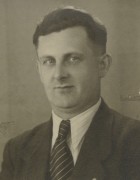
Among our identification papers and records was information about my dad. He had been drafted into the Grenadier Regiment 357, which was part of Infantry Division 214. On January 12, the day he wrote the last letter we ever received from him, his regiment was near a town called Radom in the province of Radom, in Poland. The great Soviet advance began two days later, and on the fifteenth, Radom fell and was occupied by the Russians. Was my dad taken prisoner during the advance of the Russian army? Was he wounded? Was he trying to make his way back to Berlin or had he been killed during the fighting? We gave all the information we had about him to the Red Cross authorities, and his name became broadcast on the radio as one of the missing soldiers. I kept praying that the day would come soon when we would be together again.
While we savored our American candy bars, Mutti and I told Uncle Ewald and Aunt Else about our experience with the soldiers and the tank in the center of Buckow. The radio was on, and we listened as a special news item interrupted the reading of the names. The Russians were occupying Germany from the east to the River Elbe, west of Berlin. We were amazed when we heard about the agreement the Allies had made: Berlin was to be divided into four parts. The Russians would remain in the eastern half of the city, and the western half would be divided into three sectors; to be occupied by the Americans in the southwest, the British in the west, and the French in the northwest. Now we knew why we had seen Americans in Buckow. It was located in the southwestern part of Berlin, which was now under the control of the Americans.
This meant we would no longer be under Russian control! If all the American soldiers were as friendly and kind as the two we saw sitting on the tank, our lives were about to change. We no longer had to be afraid of the Russians. We had no reason to enter the Russian sector; any of our relatives who might still be alive lived on the western side. The only time we would see Russian soldiers after the division was when they traveled from the Russian-occupied zone to the Russian half of Berlin. The division gave them access to a country road that was located about a half a mile behind Uncle Ewald’s and Aunt Else’s house.
Though much of the tracks and road had been destroyed, traveling by streetcar and bus was now possible along limited routes. Mutti and I visited Oma and Aunt Erna, and we also visited Uncle Hermann and his family, who had been placed in a Quonset hut near Oma’s home in Lichterfelde. While they waited for their neighborhood to be rebuilt, they had to help collect and clean the cement-covered bricks that were to be used in the reconstruction of Berlin.
One of our frequent trips to Lichterfelde to check on Oma and Aunt Erna included a wonderful surprise. During our visit, we heard a knock on the door; it was Uncle Willi! We had had no knowledge of his whereabouts, whether he had been killed or had survived. He had returned to Ludwigsfelde only a couple of days earlier, after he was released by the Russians from a prisoner-of-war camp. His first concern was to find out if any of us had survived the walk to Berlin. Being together was like a miracle.
He told us that the house where he and Aunt Agnes and her brother had lived was totally destroyed, but his little shoe-repair-shop building was still standing. There was no sign of Alfred, Aunt Agnes’ brother, and no one in the area was able to tell Uncle Willi what had become of him.
Uncle Willi had cleaned his workshop, arranged an area for a sleeping bag, and made the little building his home. All his shoe repair tools and equipment were still intact and he expected to be very busy with repairs. There had been no shoes available for some time and everyone’s shoes were in bad shape. When he looked at ours, he said they obviously had been worn on a long, long walk. He told us he would try to repair them as best he could on his next visit.
Uncle Willi, Mutti and I stayed with Oma and Aunt Erna for a couple of days. We reminisced. We talked about the large family gatherings of the past, the wonderful time we had spent together in the Sudetenland when Uncle Willi spent his furlough with us.
Oma, Aunt Erna, Mutti, and I took Uncle Willi to see Uncle Hermann and his family. What a surprise and what a reunion it was! Oma shed many joyful tears when she saw that her two sons and her two daughters had survived the war; they had survived the most horrible experiences one can imagine. Oh, how I wished that Aunt Agnes was still alive and that my dad had come home to be there with us. Was he on his way home? Would we be able to find a violin and a piano so that we could play together again? Would he find a way for us to immigrate to America?
When Uncle Willi returned to Ludwigsfelde, he visited Kreuzdorf to find out if my dad’s brother Max and his wife, Anna, were still alive. Since the area was located in the Russian-occupied zone, he was concerned for our safety and did not want us did not want us to try to find them.
Uncle Willi checked the area where Uncle Max and Aunt Anna had lived, but the whole neighborhood had been destroyed, and he was not able to learn if they had been killed or if they had relocated. None of us ever heard from them again, so we eventually assumed that they were no longer alive.
We also did not know anything about my dad’s sisters, my Aunt Martha and Aunt Frieda. There had been no mail service for a long, long time, and since the ordinary citizens had no telephones, we had no other way of staying in touch but to visit each other.
Since Aunt Martha and Uncle Karl, as well as Aunt Frieda, had lived in the western half of Berlin, Mutti and I decided to go and try to find them. We walked through miles of destruction and sometimes we found it difficult to know exactly where we were. Once in a while, we would see people working in the ruins, and most of the time they could help us with directions.
When we arrived in Aunt Martha’s and Uncle Karl’s neighborhood, we found that their apartment building was not totally destroyed. Even though fire had gutted the upper stories, the basement and lower apartments were still intact. My aunt and uncle’s apartment was gone, but it appeared that there were people in the remaining area. We decided to try to find someone who might know what had happened to our relatives or where they might be.
We knocked on every door we could find, but there was no answer, so we walked down the stairs to the basement. We saw another door, and when we heard some movement, we knocked. The door opened just a crack, very slowly and cautiously, and a face appeared and looked outside. We could not believe what we saw; it was Aunt Martha. It took her a couple of seconds for her to recognize us, but then she threw open the door; we fell into each others’ arms kissing and shedding tears of joy. It was quite a while before we could let go of each other, but finally we stepped inside.
We saw Uncle Karl lying on a cot, not moving, just lifting his head enough to see us. When he recognized us, he smiled and tried to lift his arms to embrace us. Mutti and I ran to him, kissed and tried to embrace him and told him how happy we were to see the two of them. Uncle Karl could hardly talk, but he did make us understand how glad he was to see that the two of us had survived, and he asked about my dad. After a short time, he fell asleep, and Aunt Martha told us what had happened to him.
During the fighting in Berlin, Uncle Karl was trying to help people hide when an explosion near him caused many pieces of shrapnel to pierce his body. There were no doctors or active hospitals, so his life was slowly coming to an end, though Aunt Martha tried to do everything she could to keep him as comfortable as possible. We were able to tell her that her sister Else and her brother-in-law Ewald had survived, and we shared what we knew about the other relatives. We talked with great sadness about the many family celebrations that took place before the war.
We wondered about her sister, Aunt Frieda, and Aunt Frieda’s husband, Hans. In the morning, Mutti and I decided we would try to learn if they were still alive. We promised Aunt Martha and Uncle Karl that we would let them know if we were able to locate Aunt Frieda and Uncle Hans. All Mutti and I knew about them was that their daughter, my cousin Lotte, had lost her life during the air-raid that had destroyed the city of Dresden. And the last information we had about my cousin Horst, Lotte’s brother, was that he was still serving with the Afrika Korps in Africa. We had no idea how the war had ended there, had no idea whether Horst was alive or dead.
We got lost again and again among the ruins. The neighborhood we were looking for was not far from Uncle Karl and Aunt Martha but it took us hours to find it. Finally we recognized the building where my dad’s sister Frieda, her husband, Hans, and my two cousins Lotte and Horst had lived. It was damaged, but parts of it looked livable. The basement area, where the air raid shelter would have been located, did not look ruined. We were able to locate the door to their apartment and since it was still in one piece, it seemed very possible that Aunt Frieda and Uncle Hans might have survived.
We knocked on the door and Uncle Hans opened it. Mutti and I could not believe what we saw. We had all become thin because of the scarcity of food, but we were alarmed to see that Uncle Hans was emaciated. When we spoke to him, he continued to stare at us. After some time, tears filled his eyes and streamed down his face. Mutti and I put our arms around his frail body and tried to comfort him, but he began to shake and sob uncontrollably. We closed the door behind us and slowly walked him towards his sofa. He sat down, and we sat on each side of him still holding him in our arms. We were all crying.
What had happened to Uncle Hans, a man who had been strong and healthy? His deformed foot caused him to walk with a limp, but he lived a normal, full life. I always thought of him as a man with great sense of humor, always making the family laugh.
After we wiped our tears, Uncle Hans said he was so glad to see us. He asked for any information we had about my dad, the family members who had survived the war, and about those who had been killed or were missing. Mutti and I wondered why Aunt Frieda had not joined us, and why Uncle Hans did not mention her. Was she one of the relatives who had not survived? Had she been hurt or killed during an air raid? Had she been shot during the battle in Berlin?
After a long silence, Uncle Hans said, “You must be wondering about Frieda. It will be very difficult for me to talk about it, but maybe it will help me to accept with what happened by sharing it with you.” He told us that a friend and co-worker of my cousin Lotte had visited and told them that Lotte had not survived the Dresden bombings. It was a miracle that this friend had survived the destruction and had been able to make her way back to Berlin. She assured Uncle Hans and Aunt Frieda that Lotte had not suffered, that she had died instantly. Her last words to her friend had been “Please tell my family….” This information was impossible for Aunt Frieda to accept. She did not want to believe that one of her two children had died.
They also did not know anything about Horst, who had been in Africa when the war ended. They had lost their daughter, and now Uncle Hans and Aunt Frieda were facing their son’s possible death. Uncle Hans tried to assure Aunt Frieda that Horst might still be alive, that he might be trying to get home to Berlin. He told us that some days she was full of hope, but most days she was full of despair, crying all day and night.
When they had eaten all of their small store of food, Uncle Hans asked Aunt Frieda to search for some provisions with him, but she did not want to leave the house. No matter how much he tried to encourage her to go with him, she wanted to stay at home. He did not want to leave her, but he had to try to find some food for them.
He had only walked a short distance when he spotted some American soldiers handing out bread, vegetables, and potatoes to civilians. Uncle Hans walked home quickly after he received the food, and as he opened their front door, he announced to Aunt Frieda that they would be able to eat after cooking the goodies he had been given by the Americans. There was no answer. He kept calling her but there was not a sound. He put down the food and went looking for her, thinking she might be asleep. She was not in bed. He found her body in the bathroom; she had ended her life by hanging herself.
We did not know how to console Uncle Hans. Aunt Frieda had been a wonderful woman and a loving aunt, and now we had lost one more relative. Mutti cooked the potatoes and the vegetables for Uncle Hans, and since it was too late for us to leave, we stayed with him for the night. When we left the next morning, we promised that we would come back to see him as soon as possible.
We stopped to see Aunt Martha on our way back to Buckow and had to share all the sad news with her. She and Frieda had been very close, and it was difficult for her to believe that her older sister had hanged herself. While we were there, Uncle Karl looked significantly worse, and this added to her sadness. He no longer reacted to anyone’s voice, including my aunt’s. When we left we told her, too, that we would be back to see her soon.
Instead of going directly back to Aunt Else’s and Uncle Ewald’s home in Buckow, we stopped in Lichterfelde to check on Oma Salzmann and Aunt Erna. They were all right; Uncle Hermann and his family had visited them just a few days earlier.
After a brief time, Mutti and I began our walk to Buckow. On the way, we talked about Aunt Else and how it would affect her to have lost her oldest sister under such sad circumstances.
 My Father's Legacy