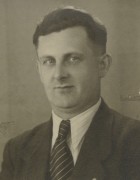
My parents, Erich and Wally, were married in a beautiful cathedral in Lichterfelde, just outside the city of Berlin. Many brothers and sisters and in-laws from both sides attended the wedding. They all knew one another from living a few houses apart, and most of them had gone to school together. It was a wonderfully close-knit family to be born into, and that’s what I did on September 6, 1929. Numerous cousins were already waiting for my arrival.
Erich, my father, had just been hired by postal department as a letter carrier, and Wally, my mother, had worked in a tailor’s shop until I was born.
As far back as I can remember, my dad always read stories to me, and before I was three years old he had taught me to write in print. (For some strange reason printing is my preferred style of writing at this time in my life.) He also helped me memorize poems to be recited for relatives’ birthdays and weddings, for Christmas and Easter and any other celebration that came along. My mom and I would pick wild flowers the day before the party, make them into an arrangement, and then the big moment would come: flowers clutched in both hands, a card printed with my own little hands, I would curtsy before the celebrant, or even the whole celebrating family, and then the poem! But the best times for me were Mother’s Day or Mom’s birthday, because that’s when Dad would help me with secret plans for a surprise party.
In the fall, all the girls in the family started getting ready for Christmas. Pot holders were crocheted for every woman in the family; they always managed to lose last year’s holders and therefore needed replacements every Christmas. As soon as they would make their needs known, the project would start all over again.
All the males in the family would admire every pot holder, and then they would ask, “When are you going to start knitting so that you can knit some wrist-warmers, or even socks, for us?”
The family gatherings always included music. Dad played the violin, Uncle Herman, Mom’s youngest brother, played the accordion, and Cousin Franz was great with the guitar. Mom, her sister Erna, Dad’s sisters Else and Martha sang in the church choir and we all joined in along with them. Some of us were pretty good and some were pretty awful, but with the love and closeness among us all, it did not matter how much you sang off-key. And then there was always Uncle Hubert, Dad’s youngest brother, who was a soloist at church. His voice made up for everyone’s shortcomings.
Christmas 1934 was very special! Dad was planning a surprise for me. However, he had told me that, unfortunately, we would not be able to have a Christmas tree this time around. Still, he and Mom would suggest different ways of making our own tree. Some of these sounded silly even to me, but some sounded possible. Dad came up with the idea of using our broomstick, drilling holes into it and inserting pine branches. It made sense to me, but I also realized it would not be as lovely as our trees had been in the past.
We went to church for the usual Christmas Eve service, and during the time we spent in church, snow started to fall softly. Walking home, I was holding hands with Dad and Uncle Ewald, Dad’s sister Else’s husband. The two of them were carrying on a conversation about the loss of the Lord’s words in church and Hitler’s words being quoted instead. Dad told Uncle Ewald how one of his co-workers had been given Hitler’s Mein Kampf at his wedding instead of the Bible, which had always been given to a newly married couple, and how the preacher had ended the wedding with the raised arm salute of “Heil Hitler.”
None of this meant anything to me. I was looking at the beauty of the falling snow and wondering if there would be any presents on the big dining room table, where each person had his or her spot. Surely the usual colored Christmas plate with cookies, fruit and Christmas candy would be in mine. Mom always placed all the unwrapped presents from and for the relatives in their designated areas on the table, and it was always a great thrill to see the wonderful and useful gifts of clothing, pencils, crayons, books, and games all at once. And then there was always the one big present: maybe a doll or skates, or even a dollhouse which Dad had built.
The whole family – well, except one or two – sat in the kitchen waiting for a little bell to ring, which meant the Christ Child had been there and we all could now enter the dining room. I had spent part of the day with Oma, my grandma, while all sorts of mysterious activities took place at home.
The moment had arrived. The bell had rung and I would be able to see the tree my dad and mom had made. I was not expecting much because even with my great imagination I could not picture it.
When the door opened I did not see the table or the presents. All I saw was a huge, beautifully decorated tree in the corner. Tears started running down my cheeks as I walked toward the tree and then stood there in awe looking up at it. I turned around and threw myself into Dad’s arms sobbing again and again, “Oh, Daddy, it’s a real Christmas tree, not a broomstick. It’s a real tree, a real tree, Daddy. Mutti, look at the beautiful Christmas tree we have.”
I remember that is was about this time when my mutti’s mother, my Oma, was visiting us, she and my dad were carrying on a conversation which made my ear perk up with curiosity. “Erich, may I ask you a very personal question?” She asked why there were no brothers or sisters coming for me, because she did not think it would be good for me to be raised as an only child.
Dad explained why he did not think it would be a good idea to have more children. He said, “It is obvious that Hitler will start a war sometime in the future. He made his plans clear in his book, and all activities and preparations prove it, even though most people only look at all the advantages he promised without concern for the consequences that will have to be paid. When the war comes, the men will become soldiers, and it will be very difficult for the women and children back home,” he continued. “Wally will have a hard time taking care of one child, especially with her bad headaches, and I think it would be better not to put the pressure of additional children on her. I pray that Edith will be old enough to take care of herself as well as her mother when I will not be with them.”
But at that point, I did not care if I had brothers or sisters. After all, I had lots of aunts, uncles, cousins, my Oma on my mutti’s side. And my grandparents on my dad’s side. And besides, Dad had studied and in 1934 he was no longer a letter carrier; he worked in the postal cars in trains where mail was sorted and money and valuables were transported. He would be away for a few days, but then we would be home for two or three days. He was my playmate, better than any brother or sister could ever be. He did keep saying that playing with dolls was really not for him, but we had all those books and games and music to occupy our time. Still, he was always telling me that he was saving to buy a toy we could use together.
The day came! Dad brought home some big, big boxes. What was in them? The most beautiful electric train set you can imagine, with tiny locomotives and cars which traveled on “miles and miles” of narrow tracks, including crossings with bells and flashing lights, platforms, buildings, trees, animals, and even streetlights. Now Daddy and I could play together! We would set up the tracks all over the dining room. He built long ramps from the floor to the top of a table, a real challenge for those tiny engines. There were no more questions about wishes for birthday or Christmas presents; my gifts were always additional pieces for the train set. One of the cars was a mail car, and I knew there were men inside sorting mail. After all, that’s what Dad did when he was away from home! And I also knew there were guns in the mail car to make sure no one would try to steal any of the valuables. Dad had been given an award for being the best shot among the postal transportation workers, and even though he never talked about it, I had seen the medal he received. It had a swastika on it and was hidden in a drawer, but when Dad was away, I would take it out and admire it again and again.

