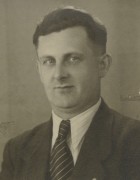
This was the first time we were riding in a regular passenger train, not in a cattle or freight car or on a pile of coal. We were sitting on upholstered benches facing each other, with a window on one side and a door with a window on the other side. Both windows were broken, so we were getting plenty of fresh air. The train was not moving quickly, so we were not in a draft, and we also had the opportunity to observe the landscape around us. We were still traveling through lots of fields and passing little villages occasionally, but we had no idea about where we were or where we were going. While we traveled, we saw many villages and even isolated farmhouses that were totally destroyed. We also saw damaged trucks and tanks at every location, but we did not see anyone alive to answer our questions about our location and our destination. We were sure that we were not traveling towards the Sudetenland, as the border would most likely be well protected, so we were convinced we were traveling in Germany. But where to? Did it really matter? We did not know if Oma’s home was still standing, nor did Uncle Hermann know if he and his family still had a place to live. Mutti and I knew we had nothing left in Berlin. But where was Dad? Was he already back in Berlin? If he was there, how would we find each other? His birthday, on May 26, must have passed, but we could not be sure, since we had no idea what the date was. We did wonder: was he now thirty-nine years old or was he still thirty-eight?
In the afternoon the train stopped, and all passengers had to disembark. It had not pulled into a station; it just stopped. We climbed out of the carriage and found ourselves walking through fields again. After a short walk, we spotted a few vehicles and other people not too far away, so we headed towards them and joined them. These people were also refugees who had no idea what location they were at, or where they were going.
We were passing through a tiny village and saw a woman standing at the front door to her house. We asked if she could give us some drinking water but she refused, went inside and shut the door. We were disappointed, but a few miles down the road, we saw a farmer standing by the side of the road. He stopped us and alerted us that curfew was approaching. The Russians strictly enforced curfew and would shoot any German seen outside after six o’clock. They would not ask any questions. The farmer pointed to his very large barn a short distance from the road and told us we were welcome to spend the night in it. He even gave everyone a boiled potato and some water to drink. We were grateful that he was so different from the uncaring woman we had met earlier in the day.
The barn was filled with hay and a few animals. Before we went to sleep in the hay, we talked with some of the other refugees. Their stories were similar to ours; like us, they did not know if they had a home to return to, if any relatives were still alive. Many of them had lost family members during their walk; some had been killed, but others had died of starvation, dehydration, or disease. Their worst memories were of the moments that they had to leave the dead bodies behind and keep walking. There were no burials and there was no way of knowing exactly where their loved ones had died, or what would be done with the bodies. The eight of us realized how fortunate we were to have made it this far, and to have the strength to keep walking.
My grandmother was the one who had major physical problems, and we were always concerned about her. The ulcers on her leg were not healing, and since we had no ointment to put on them, the bandages would stick to the open sores. Once in a while we were able to moisten a bandage and try to clean the sores, but we rarely had a chance to rinse the blood and pus out of the bandage. Though uncomfortable, she never complained. She kept telling us, “I am going to make it with God’s help. He knows I want to be buried back home in Berlin.”
The curfew ended at six a.m. and gradually, people were waking and leaving the barn to start another long day of walking. Like the others, we walked all day with only a short rest in the shade under some big trees. When it was getting close to curfew time, Uncle Hermann and some of the other refugees started looking for cover to protect us during the night. They finally spotted a burned-out house a short distance from the road and decide to use it as a shelter. It did not take very long for what remained of the building to fill with people. We all tried to be very quiet, because we feared that the Russians might consider our roofless, windowless, and doorless shelter as the outdoors. Thankfully, we all made it through the night, and everyone started walking again in the morning.
During the day, Uncle Hermann always tried to talk to some of the people living in the area to get an idea of the direction into which we needed to walk. We not only had to keep heading towards Berlin, but we always needed to make sure we would reach some sort of cover before six o’clock. There were many days when we could not make much progress because the distances between little towns or villages were too great to walk in the twelve hours that we were able to be outside, but some days we were very lucky. Someone would hand us a piece of bread, or a boiled potato, a piece of fruit, and sometimes a drink of water would be offered to us. We certainly appreciated every gesture of kindness shown us. We were totally dependent on it.
One of our daily trips ended up being a horrible, painful experience. We found out in the morning that we would have enough time to reach the nearest village by curfew. An inn was taking in refugees, and we should be able to get there before six p.m. We did. We arrived at the inn just a few minutes early, but when we entered, we were told the inn was so overcrowded that we would have to find other quarters for the night. We asked Russian guards outside the building what we should do. One of them knew some German. He understood our questions and told us the next village was only a few kilometers away, but, since it was now curfew time, we could expect to be shot on sight. We would not be asked why we were outside; no excuses were accepted. Being shot was the price for not following Russian rules.
We had no choice but to run. Run we did! We ran faster than we thought we could. We had Oma put her arms on my and Uncle Hermann’s shoulders and we ran with her feet hardly ever touching the ground. Aunt Dora was holding Gerhard and Gunther, pulling them by their hands, and Mutti and Aunt Erma carried our few belongings. Before we reached the village, we saw some Russian soldiers beside the road. We knew we had reached the end of our lives, since we were still outside after the curfew.
One of the Russian soldiers walked towards us and stopped us. His German was very limited, and we knew we were in trouble. We were incredulous when, after pointing at his wristwatch, he pointed at a building not too far down the road, apparently trying to tell us to get there as quickly as possible. He had not aimed his pistol at us; he let us go! We could not believe it! We kept looking back, thinking he would shoot us from behind, but we continued running as fast as we could and we finally arrived safely at the inn.
The place was crowded with men who had been taken from their countries and their homes by the Nazis, who had brought them to Germany to fill the diminishing labor force. The Nazis had drafted these Old men and fourteen-year-old boys into the military or the “home-defense forces.” Because we were Germans, we expected the men to treat with anger and resentment, but they were kind and concerned instead. These men were now trying to return to their homes just as we were. The Russians had given them some food, and they did not hesitate to share it with us. Nor did they hesitate to share their bunk beds with us. One Frenchman shared his bed with Mutti and with me, and even though we felt extremely crowded, we slept well. The men treated the rest of our family with the same kindness, and we all felt rested in the morning. We hated to leave the inn, and the men who had shown us so much kindness, but we knew we had to keep going. After many hugs, kisses and expressions our appreciation for their kindness to us, we were on our way.
We started seeing signs pointing towards Dresden, which seemed like a good destination for us. After all, my dad’s work had taken him to Dresden many times. We thought there might be some train service from there back to Berlin.
Now we had reached the first big city on our walk back to Berlin, but we could not believe what we saw. There was almost nothing left of Dresden. Blanket bombing and ground fighting had destroyed almost the whole city, and we wondered if we would be able to find a place where could stay for the night. We encountered very few German citizens, but there were lots of Russian soldiers moving through the remains of the city.
We were walking along a fenced-in area with wooden barracks and a small building with a Red Cross painted on the door. We had just reached an open gate in the fence when we noticed a man leaving the small building. When he saw us, he came walking towards us. Uncle Hermann asked him if he could suggest a place where we could spend the night. We were relieved when he told us we were welcome to stay right there. Russian prisoners-of-war had been kept in the barracks, but they were now empty. The man had been a Red Cross worker in the prison camp, and he was still there, not knowing what to do or where to go. He let us choose one of the barracks and we picked one close to the Red Cross building.
We could not believe our good fortune. We had a place to spend the night. The building we had picked consisted of one large room enclosed by thin wooden walls. There were no windows, only the door to the outside. We longingly looked at the bunk beds in the room, and all we could think of was that each of us would have a choice of where to sleep. The room was very dirty, but quickly improved as the women busily swept and scrubbed the place with supplies from the Red Cross building. The worker tried to make us as comfortable as he possibly could; he even gave us clean sheets for our beds. He did not have any food to share with us, but he thought he might be able to find some for the next morning. At least we had water to drink, from a spigot outside that sprinkled enough water for us to wash ourselves. Our new friend even supplied us with a bit of soap, and we felt cleaner than we had in a long time. He did caution us not to go outside after the curfew because there would still be lots of Russian soldiers outside. He gave us a bucket to use for a toilet, so we had all the comforts we could ask for – we thought!
We were cleaner than we had been for some time, and we each had a bed of our own with clean sheets on it. What more could we possibly ask for? We had finished our cleaning work, and feeling totally exhausted, we climbed into our beds. Uncle Hermann’s bed was closest to the light switch, and once we were all comfortably tucked between those clean sheets, he turned off the light and crawled into his bed.
We were looking forward to some needed rest, but it was not to be. In truth, it turned out to be one of the most horrible nights we had ever experienced. Within a few minutes we were all being bitten by some kind of bug. We were covered with them! Uncle Hermann jumped out of his bed and turned on the light. We found our bodies, our beds, the walls, the ceiling, and the floor totally covered with bedbugs, a wingless odorous insect that infests dwellings and bedding and feeds on human blood. It did not matter where you looked; all you could see was a blanket of crawling bugs. We helped each other wipe them off our bodies, but all of us were already covered with huge welts from the biting and blood-sucking pests.
What to do? We could not leave the room and go outside; we had to find a way to spend the night totally surrounded by bedbugs. We swept clean an area on the floor just big enough for all of us to sit close together, and we shook the bugs off one of the sheets and put it on the floor. We sat there all night long killing bugs. They dropped on us from the ceiling, and we had to watch the floor all around us. We protected each other. We were covered with spots of blood from killing the bugs that had already bitten us. The stench of bedbugs, alive or dead, is indescribable, but we had no choice but to live with it for the night.
At six o’clock in the morning we all ran outside. We helped each other pull off the bedbugs that were still clinging to us, and then we took turns getting water from the spigot to splash on all the burning welts all those hungry insects had left on our bodies.
The Red Cross worker had not spent the night at the camp. He had found friends who owned a basement apartment, and he had stayed with them. He brought us some bread and some fruit for breakfast and he could hardly believe our traumatic night. After hearing our story, he released some kind of smoke can in the barrack we had occupied. The smoke was intended to kill all insects inside that building, and it certainly did. In the afternoon, we helped to clean out the room where we had spent the night. We swept and carried dustpans and even shovels full of dead bedbugs outside the barracks, and before curfew came, we had filled a huge metal drum. The Red Cross man told us to move into the building he had occupied in the past. Although he would be staying with his friends, he would visit the camp and us every day. Before moving to the Red Cross building, we tried to remove the remaining bedbugs that were hiding in the seams of our clothes and any tiny crevice in our shoes, and we cleaned them out from between the paper documents we still carried with us.
The little Red Cross building was much smaller than the room where we had spent the previous night; it did not have enough beds for all of us, but somehow a couple of blankets on the floor were sufficient. There were no bedbugs bothering us. Only a few fleas were hopping around now and then, and since they did not bother us, we were able to totally ignore them. The prior occupant made everything as comfortable as possible for us. He even told us we could stay there as long as we wanted unless Russian soldiers decided to occupy the camp; they would probably force us to leave. Maybe the Red Cross signs on the building might offer us some protection.
We decided to try to stay there for a while to get some rest. Maybe we would be able to discover what had become of Cousin Lotte. During the day we tried to get some food, and we asked questions of anyone who was willing to talk to us, to try to learn news about the rest of the country. Before curfew time, however, we made sure to return to our cozy little building.
Although we were able to rest, we always had to be alert, because the Russians might enter our quarters, especially during the night. During the day we had to find some food, but there were times when we observed circumstances that made us want to laugh, not out loud but certainly on the inside.
The soldiers seemed to be very fond of our wristwatches. Most of them were wearing an abundance of them, from their wrists to their elbows on both arms. We noticed that they would always check out everyone’s wrists to see if there might be one more watch to add to the collection. The Russians had taken all our jewelry from us on our walk back to Aussig, but my mom had hidden her and my dad’s wedding bands by sewing them inside the hem of her pants. They were so well concealed that they were “survivors” of the war, and so was the watch Dad’s Russian friend Josef had given him.
All those watches on the soldiers’ arms were a ridiculous sight, but then we ran across an even funnier circumstance. One of the soldiers was trying to ride a very fancy, seemingly brand-new bicycle. He obviously had not been on a bike before. Watching him amused us, but then it became even more hilarious.
A boy came riding along on an old, decrepit bike. He was not holding on to the handlebars; he was carrying a bag of potatoes clutched to his chest. His balance was perfect. He was traveling in a straight line when the Russian soldier spotted him. Obviously amazed by what he saw, he watched the boy for a minute or so. Then he fired his gun into the air. Everyone stood still wondering what was happening. The boy stopped riding his dilapidated bike but hung onto his bag of potatoes. He looked scared when the soldier started walking towards him, dragging along the handsome new bike. Apparently the boy thought the Russian wanted his bag of potatoes, and he tried to hand it to the soldier. But the Russian pushed aside the bag of potatoes and motioned for the boy to give him his bike. He grabbed the old bike and handed the boy the handsome, new bicycle he had tried to master. The boy got on the new bike, and pedaling as fast as he could while holding on to his potatoes, he left the scene. We could not imagine why the Russian was willing to make that exchange. Maybe he wanted to show some kindness to a youngster? But then we saw what his reasoning must have been: this old bike just needed to be pedaled. After all, the boy had not even had to touch the handlebars!
The Russian climbed onto the bike, shifted his weight back and forth until he was seated comfortably. He then started to pedal without touching the handlebars. Of course, the result was disastrous. While attempting to copy the boy, the Russian soldier kept losing control and falling as the bike tipped. None of the people watching him dared to laugh out loud, but when we exchanged glances, we could tell that everyone wanted to laugh. After a few more tries, the soldier threw the bike down, kicked it, and walked away. Immediately some of the observers who had just shared laughter ran to the bike, and a fight began while several people tried to take possession of that rickety bicycle. We left and walked back to the camp.
We had found a few potatoes and some carrots to prepare our usual watery soup. No one complained about it; we considered ourselves very lucky to have something to eat.

