After we had been given permission for me to move to Weissbach, we went to see Oma Salzmann and Aunt Erna. Since Oma had been with us on one of our vacations, she knew all about the area that Mutti and I would now call home. When she and Aunt Erna wondered if it might be possible for them to join us in Weissbach, we wrote to the Zimmermanns immediately. We hoped that they would somehow be able to find space for two more.
We started getting ready for our move to Weissbach. Mutti and I were each allowed to take one suitcase with us, which we packed with as many clothes as possible. A list of the contents had to be taken for approval to local officials, who would approve, sign, and stamp the list prior to our departure. Mutti was planning to return to Berlin in the near future to pack another suitcase with clothes and, if there was enough space, some of our valuables.
On August 10,1943, just four weeks before my fourteenth birthday, we left our home, left our neighborhood, left our city, Berlin, and traveled to Weissbach.
When we arrived, we were welcomed by Mr. and Mrs. Zimmermann, their daughter, and Dietrich, their little grandson. As hospitable as always, they served us homemade bread and butter, made in their own butter churn. We all sat around their huge kitchen table enjoying the food while they explained that they had not been able to find a place nearby for Oma and Aunt Erna. However, they had a solution; the room Mutti and I were to occupy was large enough for three beds, some easy chairs, a large table, a large chest of drawers, and a good-sized closet. If Mutti, Oma, and Aunt Erna could sleep there, I could have a bed under the roof, right below a window and just next to the hayloft. We would be welcome to use the huge kitchen at any time if our room felt too crowded. This sounded great to us, so Mutti immediately wrote to Oma and Aunt Erna and shared the good news with them..
The day after our arrival, Mutti and I went to the school I would be attending. It was located in the nearest village to Weissbach called Haindorf, but to our amazement, it took well over an hour to reach it, as it was only accessible by foot! Yes, it was quite a distance, but the surroundings were so beautiful that it was a pleasant trip except when it was raining or snowing. Best of all, a girl named Gretchen lived very near the Zimmermanns’ house, and she walked to school with me every day. She did not mind that my name was Kanter, and she did not mind that I was not part of the Hitler Youth. She just accepted me the way I was. Just days before my fourteenth birthday, I finally had a friend. Outside of school, we did not have much time to spend together. Since her mother had to work, Gretchen had many chores at home, which she completed in addition to her homework. But we had plenty of time to get to know each other during our long walks to and from school every day.
In Weissbach, Mutti had taken care of all the official duties, so she made plans to return to Berlin to pack some additional belongings. In Weissbach, she had registered for temporary residency, reported the items we packed, applied for our food ration cards, and satisfactorilly answered all the local officials’ questions. I was not allowed to go home, so she would have to travel by herself and as quickly as possible to avoid air raids. Officials had granted permission for Oma and Aunt Erna to come to Weissbach, so when they arrived on August 21, Mutti felt free to go home to Berlin. She left by train early in the morning of August 24.
Oma tucked me into Mutti’s bed while she was gone. It was nice sleeping in a real bed and being with Oma and Aunt Erna, but I did miss my cot beside the hayloft. On my first trip to the attic, I climbed the ladder and found the Zimmermanns’ cat resting on a little shelf near the window in the roof. She watched me intently, probably wondering what I was doing in her quarters, but before the first night was over she decided to join me on my cot. The cat reminded me of my teddy bear, and I wondered if he missed me as much as I missed him. Before Mutti left, she had promised to try and squeeze him into the one suitcase she would be able to pack. I longed to practice my piano lessons with my teddy sitting beside the music or at the end of the keyboard, and I longed to read my favorite books out loud to him or pretend to share my food with him.
The biggest difference between my teddy and my new bed-fellow was that she wanted to share her food with me. Almost every evening she would have a dead mouse tucked away on the cot for me, or, sometimes, she would catch one during the night and usually place it carefully on my pillow near my face. It did bother me in the beginning, but her snuggling up to me, especially on cold nights, was worth the price of dealing with dead mice. I loved looking up at the sky through the window in the roof over my cot. I would see stars and sometimes the moon, but at other times raindrops or snowflakes obstructed my view. However, when it was freezing outside, my kitty and I kept each other warm. She must have missed me when I slept in Mutti’s bed. When she saw me the next day she came running to me, sat beside me, and I knew she was trying to ask me where I had been the night before.
On her way back to Weissbach, Mutti would travel by train from Berlin to Gorlitz, then she would transfer into a smaller train, which would take her to Reichenberg. In Reichenberg, she would change to the little old-fashioned train with its bells and whistles, the same train we had watched from the mountain tops during our vacations.
The little train arrived from Reichenberg every day around the time Gretchen and I passed the station on our way home from school. After Mutti had gone to Berlin, I decided to wait there each afternoon for its arrival to see if Mutti was on it.
Mutti’s visit to Berlin was very short. She came back in a couple of days. When she exited the train, she was not carrying a suitcase, and her clothes, her legs and arms, her face and her hair were totally covered with soot and ashes. The only part of her that was not black were her cheeks from all the tears she had been and was still shedding. I ran to her, put my arms around her, and asked her what had happened. She sobbed and whispered, “It’s all gone! Our home is all gone, and everything in it is gone! Our whole neighborhood, all of Lankwitz, was destroyed by fire bombs the night before I left here. Oh, Edith, what are we going to do? We no longer have a place we can call home, and everything we had, everything Dad and I worked so hard for is gone, burned up in a fire. I tried to see if there was something in the rubble that would remind us of what we had, but there was nothing left.”
We both sat down and cried. Mutti did not have to explain what the damage from fire bombs looked like; I had seen it in the past. However, the difference this time was that it had been blanket bombing. Out of more than 57,000 residents in our suburb, some had lost their lives during the air raid and over 48,000 were left homeless. Much later, we found out that the Nazis had built hidden laboratories in Lankwitz, and throughout the city, scientists were conducting tests to perfect radar and to create lethal weapons. These hidden laboratories needed to be destroyed by a large-scale bombing, which would ensure that the secret work was stopped and destroyed.
But while Mutti and I were sitting there crying and holding each other, I just kept thinking: How was it possible that everything was gone. Our clothes? Our train set? My piano and all my music? My bookcase with all my books? The dollhouse Dad had built for me? Dad’s violin? My doll carriage and all my dolls? My teddy bear? I felt as though my whole childhood had disappeared during one night, during one air raid. Thankfully, the destruction of our home entitled Dad to come home on furlough. And Oma and Aunt Erna still had their home.
Mutti had more news. Uncle Hermann had worked as an engineer in a company which designed and built defensive as well as offensive weapons. It too was totally destroyed during the air raid. His work had been so important that he was allowed to keep his family – Aunt Dora and my cousins Gerhard and Gunther – with him in Berlin. Now without his job, Uncle Hermann would be drafted, and his sons would have to leave the city. He was hoping that Mr. and Mrs. Zimmermann might be able to find a place for them in Weissbach.
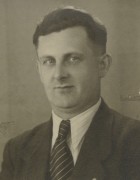
Within a week after Mutti’s return from Berlin, Dad arrived. We were overwhelmed by our loss and our uncertainty about the future, but within a short time, Dad’s strength assured us that all would be well. He said, “Since we have no reason for returning to Berlin, why don’t we apply for permanent residency here in the Sudetenland? After all, we love the area and you would receive some restitution money to help you get settled here. We have nothing to return to, so why not stay here?”
Oh, yes! Dad gave us a future to think about, plans to work on, and a way of dealing with our loss. He helped us apply for permanent resident status and was also instrumental in Mutti’s receiving 500 German Marks from the government in order for us to try and replace some of the winter clothing we had lost.
Dad’s time with us was much more wonderful than any present I received on my fourteenth birthday on September 6. Having him hug and kiss me and hold me close was the best gift I could have asked for.
A few days before Dad had to leave us, the two of us went for a walk to the top of one of the lower mountains. It was a beautiful day, clear and sunny, and the view was great. We sat down and Dad said, “Mickey Mouse,” which had been his nickname for me for many years; according to Dad, my upturned nose was as cute as Mickey Mouse could ever be. He continued, “I have something to tell you and a promise I will ask you to make. When I leave Weissbach, I will return to Norway. When I get there, I will be sent to the very front lines in Russia. It means I will be with the fighting army, and it also means I may not survive the war. I need for you to promise me that you will always do your very best to take care of your mutti. Will you do that for me?”
I started to cry, and Dad held me tightly. I asked, “Dad, why will you be sent to Russia? Why won’t they let you stay with the occupation forces in Norway?”
After thinking a while, he answered, “Edith, it really does not matter. Something happened before I came home that got me in trouble. Please, Dear, give me your promise to look out for Mutti.”
I asked him to tell me what had taken place, but he told me again that it did not matter. All that mattered now was my promise. I told him, “Dad, I promise you I will do what you ask, but won’t you please tell me why you are being sent to Russia?” For a long time, Dad sat in silence, wiping my tears as I cried. Finally he spoke and explained what had taken place in Norway.
He said slowly, “Maybe I should tell you what happened, because I had to make a choice, and you may have to make a similar decision in years to come.” He continued, “I was ordered to go to the headquarters where the highest officers of our company were located. This was right after I was told about the air raid, and, because I was expected to help you and Mutti get settled in Weissbach, I was entitled to a furlough. “All the officers were sitting around a big table wrapping up all sorts of valuable items. It was mostly jewelry but also beautiful small antiques. I was told that I was to hand-deliver the packages to their families on my way to Weissbach. I told them that I could not deliver the packages because I needed to arrive in Weissbach as quickly as possible and that you and Mutti needed me.
“They all looked at me. I guess that they were surprised at my answer. They must have expected me to just say ‘Yes sir!; and be on my way. Finally, the highest ranking officer stood, came close to me and said, ‘Kanter, this is an order!’ I thought for a moment and then I said, ‘Sir, I have to refuse to follow the order.’ He stared at me and finally he spoke. ‘What do you mean, you have to refuse our order?’
“I asked God to give me the strength to answer him truthfully, and I said, ‘Sir, I do not want to be involved in transporting of stolen goods out of a neutral country.’ All of the officers stopped wrapping and stared at me. I guess they could not believe what they had heard. The commanding officer, who had given me the order, turned bright red and said, ‘Kanter, unless you change your mind right now, your order for placement at the front lines in Russia will be waiting for you when you get back.’ I saluted and left.
“So you see, Dear, my refusal will have consequences for me, but don’t you agree that it was the right choice for me to have made?” I had to agree with him, but his being sent to Russia was not good news, and when he left a couple of days later, his leaving was full of tears and hugs arid kisses once again.
I did have the chance, though, without Mutti hearing me, to whisper in his ear, “Dad, I will keep my promise!”

