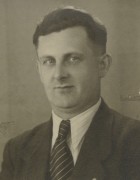
In 1942, plans were made for the members of the family who had not been drafted to spend Christmas together. The gathering was to be held in Berlin at Aunt Martha’s and Uncle Karl’s home. Opa Kanter had died in August and Oma was now living with them. Everyone planned to bring all the letters and pictures they had received from the relatives who were now serving in the armed forces. Uncle Willi was still stationed near Berlin and was able to join the get-together. Uncle Hermann, Mutti’s youngest brother, had not been drafted. He was an engineer involved with designing air defense weapons, and his work allowed him to live at home with Aunt Dora and my cousins Gerhard and Gunther.
My Aunt Erna, Mutti’s oldest sister, had lived in Stralsund at the Baltic Sea, but when her husband died she moved back to Berlin and was now living with Oma Salzmann. On my Dad’s side of the family, his older brother, Max, and Aunt Else’s husband, Uncle Ewald, had not been drafted because of their advanced age. The same applied to Aunt Frieda’s husband, Uncle Hans. Their daughter, my cousin Lotte, lived and worked in Dresden, but because of the distance we did not get to see her very often. She and my dad did get together when his work took him to Dresden. Her brother, Horst, had been drafted and served in the Afrika Korps under General Erwin Rommel. Uncle Hubert, the younger brother, had advanced to one of the top positions in the Nazi party in Berlin and no longer associated with any of the other family members.
My cousin Franz, whose mother had died in childbirth, was a foot soldier in the army in Russia. When he was home on furlough, he had asked me to write to him as often as possible since the adults did not always have time for writing. Since I loved to write, I kept him as well as Horst informed of the happenings at home.
But Christmas 1942 turned out to be a very sad time. Oma Kanter had received notification just before the holidays that Franz had been killed in action on the Russian front on December 3. His death affected all of the family and it marked the end of our peace and happiness with many heartaches yet to come.
In addition to the pressure my parents endured from Hitler Youth officials, Dad now had to face a major problem at work. When he was called into the main postal service office for a meeting, his supervisor informed him that draft notices had been sent to their office before the employees would receive them. The supervisor said, “We are required to inform the draft board which of the workers we can do without and which ones we need desperately. We have your draft papers in our hands, but we need you to continue your job. It was brought to our attention that you are not a Nazi party member. We cannot keep you from being drafted if you do not join the party.” Dad told the supervisor he was unable to join the party since he did not agree and never had agreed with Hitler’s teachings, and that he was and always had been against the beliefs of the party. His supervisor could not believe what he was being told. He told Dad to go home, think it over very carefully, and give him an answer the next day.
The three of us talked and prayed, and eventually Dad explained to Mutti and to me that sooner or later he would no longer be needed at work anyway since trains and cities were being destroyed by bombs. He said that the advantage of being at home a little while longer was not worth his going along with something he had taken a stand against ever since it started in 1933: Hitler’s vision and plan for Germany and the world.
Before Dad could tell his boss he had not changed his mind, the supervisor happily informed Dad he would not have to become an active member of the party. All he was required to do was to pay weekly dues. Dad answered, “I would be supporting the Nazis financially, and I just cannot do that. I guess my only option is to go along with being drafted.”
The supervisor looked at Dad in disbelief and remained silent. After a while, he said to Dad, “May I call you Erich? Part of me thinks you must be crazy, but, confidentially, another part of me admires your strength. It is too bad more of us did not feel the way you do when our country accepted all the promises the Nazis made. We were promised a growing, stable economy, a Volkswagen for every family, free education for our children and even free health care. The government was going to take care of all our needs from our cradles to our graves, and look at what they have done for us. We have started another world war and citizens are losing their lives all around us. What a price we are now paying for all the promises we accepted! I wish you well, my friend. You have been the best marksman in our annual tests for years now; I shall expect to see you back on your job when the war ends.”
We decided to see as many relatives as possible before Dad would be drafted. Since this was before we had telephone service, the only way we had of staying in touch with them was to visit them or to write each other.
Most of the relatives had nothing but sad news to share with us. We went to see Uncle Max and Aunt Anna, who were still mourning the tragic death of my cousin Pauline. Uncle Max told us that they had just received notificiation that their son, my cousin Karl, had been killed in action. In addition, Aunt Anna’s sister, Suzanne, had just learned that her sons were missing in action, and that her husband had just been drafted into the navy. Other than crying with them, we could not think of a word or a way to lighten their burden.
On our visit to see Aunt Frieda and Uncle Hans, we found out that Uncle Hans’ brother, his sister-in-law, and his three nephews had all died in an air raid in Hamburg. All those heartaches, along with worrying about Horst in the Afrika Korps and Lotte’s living in Dresden, had left the two of them with no feelings other than despair and sadness. Lotte had tried to return to Berlin to be with her parents, but she did not receive permission to leave her job in Dresden.
Uncle Ewald was born and raised in the Rhineland and had remained in touch with all his relatives by mail and even an occasional visit, but there were no more letters from any of them. (After the war, he tried to find out if at least one of them had survived, but he was never able to find out what had happened to them all.)
Uncle Karl, Aunt Martha’s husband, had many brothers and sisters and lots of nieces and nephews with whom I had played many, many times. Some of the young men had been drafted and some of the girls had been placed in Hitler Youth camps. They had been active members of the Hitler Youth and had, supposedly, been relocated to safer areas. (When the war ended, however, we found that none of Uncle Karl’s relatives had survived.) When we went to visit him, Aunt Martha, and Oma Kanter, who had been living with them since Opa Kanter had died, we found out that Uncle Karl had just received his draft notice.
Oma Salzmann and Aunt Erna lived in Lichterfelde, the suburb adjacent to our town of Lankwitz and Uncle Hermann and his family lived a short distance from Oma, also in Lichterfelde. Their proximity made it possible for us to walk to visit them on a regular basis, and being with my cousins, Gerhard and Gunther, meant a lot to me. I did not have any close friends, so the time we spent playing together was special to me. Since the war had started, one major change had taken place. If we expected to stay with any of them for any length of time we took with us the food we were planning to eat for our next meal. Everything was rationed and scarce, and no one ever had anything extra for hosting company.
Dad received his draft notice and had to report to the required enlistment station on the first day of March in 1943. All we knew was that he was going to be in the army but we had no idea where he would be sent for basic training. It was a very difficult day for the three of us. During all the years of turmoil we had had each other, we were able to talk to each other and to encourage each other, to pray with one another and to cry together. How would Mutti and I survive without Dad’s strength supporting us?
Four days later, on March 5, Dad sent us a letter that was an answer to our prayers. He was stationed in Potsdam, which was not very far from Lankwitz, and we were allowed to visit him. Unfortunately, he did not know any specific time when he would be allowed to see us. We did not care. Every day, we packed our food and headed to Potsdam early in the morning so that we could see Dad whenever he was free for a few minutes, or sometimes even an hour or two. I skipped school, but it was no longer a problem. Because of all the air raids, classes were constantly interrupted and no one paid attention anymore as to who attended and who did not attend class.
Mutti and I took walks in Potsdam between the times when we could see Dad, and since the Potsdam area had few air raids at the time, there was peace around us. We had a chance to visit old churches and castles, including Sans-Souci, which meant “without worry.” When we had a chance to see Dad for an extended time, he explained much of Potsdam’s history to me. Frederic the Great had planned and built Sans-Souci in about 1745 on top of a hill above beautiful terraced gardens. We had a chance to talk about Germany’s history, which I had never been taught in history classes at school. (All we had been taught was the unfair treatment Germany had received at Versailles after the first World War and the years after the war when Hitler came to power.) I was given a chance to look at some of Germany’s history, a Germany of the time before Hitler and the Nazi movement, a Germany where Jews, Slavs, handicapped persons, and other “undesirables” were not being used for experiments or tortured and put to death in concentration camps.
Dad was being trained to become a wireless radio operator, and he seemed to be at peace with it; however, at times Mutti and I noticed a lack of his usual cheerfulness and smiles. Mutti would question him but he would only give us vague answers. But there was a time when he explained having bad pains in his back and his knees and he said, “Well, a few of us who are not Nazi Party members get some extra duties to carry out,” and he added, laughing, “You should have seen three of us scrubbing down a lavatory with our toothbrushes this morning!” Mutti and I started crying but he said, “Don’t cry! Other than pains and aches afterwards, we did not mind. It was great for us to find out that there were a few who had not joined the party.”
Over the next two months, we spent much time together, but it was soon necessary to say good-bye. Dad was able to tell us at what time and from which railroad station he would be leaving, but he had no idea where he and his comrades were being sent.
Mutti and I were already waiting at the station along with relatives of some of the other soldiers, when my dad and the other soldiers came marching into the station. Dad spotted us at once, and we kept hugging and kissing each other and crying until Dad had to enter the train. He was able to stand at a door with an open window and even though he was too high for us to touch him, we had a chance to keep talking. Tears were running down Dad’s face, and Mutti and I were crying uncontrollably. When the train started moving we walked along beside it until it started going too fast. We kept waving until Dad was out of sight. Our tears would not stop; the second parting was even more painful than the first! It was evening when Mutti and I arrived at home, and we immediately crawled into bed together, holding each other tightly while we cried and prayed. After a short sleep, the air raid sirens sounded and we headed for the shelter.
These days, we were spending much more time in the air raid shelter. At night it was the British bombers who sent us there; during the day it was the Americans. An air raid warden, wearing a helmet and carrying a gas mask, would stay outside the shelter to make sure everyone could find their way when the sirens sounded. Since absolutely no lights were allowed during a raid, it was difficult to get to the shelter when there was no moonlight to guide us. When the first bomb fell close to our neighborhood, we could feel it and hear it, and only afterwards would the air raid warden join us in the shelter.
Mutti and I went to visit Uncle Ewald and Aunt Else; they invited us to stay overnight with them, which gave us time to talk about the past and all the good times we had spent together. They reminded me that I always stood on a chair behind my aunts when they were all sitting at the big dining room table playing cards, and even though I was very little and very young, I would redo their hairdos and reassure them that I would be their hairdresser when I was old enough. Now that I was thirteen, I had to admit that hairdressing was no longer my dream for the future, but it had been fun having aunts who let me create a mess of their hair.
Uncle Ewald and Aunt Else lived in a rural area in which a development of duplex houses had been built, and every resident had a large amount of land around their part of the house. It was wonderful to be picking fruit off bushes or trees or to be helping to pick strawberries or the vegetables that Uncle Ewald had planted. Their next-door neighbors were Mr. and Mrs. Muller, who had become close friends. They had joined us in reminiscing about the past. Each year in the fall a “Harvest Feast” had been celebrated with clowns, merry-go-rounds, costumes, and, of course, fireworks. They were wonderful memories to recall! The Mullers had one son who had been drafted and was now fighting on the Eastern Front in Russia. Mr. Muller had not been drafted because of his advanced age, but he had volunteered to be the air raid warden for his neighborhood.
Shortly after Uncle Ewald, Aunt Else, Mutti and I had gone to bed, the sirens blared. We always laid out our clothes so that we could dress and get to the shelter as quickly as possible. We pinned to our clothes a little pouch that had our identification cards and whatever other documents we had obtained from the government, along with our ration booklets, any money we had at the moment, and a list of the names and addresses of our relatives.
Mr. Muller was standing at the entrance to the shelter, and, as was customary in Germany, he quickly shook hands with everyone. I still remember that I also received a big hug from him along with the handshake. We heard the anti-aircraft guns firing, but it did not appear that much else was happening. Suddenly a tremendous noise brought down bricks and cement from the walls and ceiling, and the floor heaved back and forth, toppling all of us off our seats. The people seated nearest to the entrance, where I also happened to be, immediately voiced concern about Mr. Muller, who had not come into the shelter. Five neighbors quickly ran outside. Mutti was helping to clean up the debris and check others for serious injuries, and since I was most concerned about Mr. Muller, I also ran outside. Searchlights and flares dropped from the airplanes illuminated the area near the entrance, and after a few minutes we found Mr. Muller lying on the ground. We noticed that his helmet was gone, but when we turned him onto his back, even in the semi-darkness we saw that his head was gone.
For a few seconds there was silence. Nobody moved, nobody spoke; everyone stared and could not comprehend what they were seeing. And then one of the men said, “Oh my God! His head! Where is his head?”
I could not move, I could not think; I just sat near Mr. Muller’s feet with one of the female neighbors. The others kept finding small pieces of flesh around Mr. Muller’s body, and they realized that his remains were all over the ground. One of the men approached the woman sitting next to me and said, “Please go and get us some containers and spoons or some kind of tools for scraping up what is on the ground. And please hurry up! We don’t want Mrs. Muller coming outside and seeing people stepping on pieces of his head.”
For a moment the woman just stared at him, but then she got up quickly and ran to her home. The man looked at me and asked, “Have you been here since we came out of the shelter?” I was not able to talk, all I was able to do was to nod my head. He helped me stand, and with his arms around my shoulders, he walked me back toward the shelter, trying to console me but also asking me not to tell anyone what I had seen. “We don’t want Mrs. Muller to come running outside before we have done what we can do,” he said.
Mutti and the others in the shelter were still cleaning and straightening and bandaging the injured, one of whom was Mrs. Muller. I sat down. After awhile Mutti glanced at me and after studying my face, she asked, “Dear, are you all right? Do you feel sick? You look so very pale.” She put her arms around me and in return I clung to her as tightly as I could. After a while she looked at me again, asking if I was all right. I nodded, trying to tell her all was well. But it was not! I wanted to cry, I wanted to scream, but I could not. Mrs. Muller was not going to find out from me about Mr. Muller, and deep down inside I felt, since my Dad was not with us, I needed to protect Mutti and not share with her what I had seen. I felt numb. What I needed was Dad’s strength and encouragement to keep me going.
After Dad had left Potsdam, we did not hear from him for a while. When we finally received a letter from him, he used a code that we had created to tell us that he was with the German occupation forces in Norway. It was a prayer answered and a great relief for us. We now knew that Dad was not in an area where his life would be in constant danger.
In the first letter Mutti wrote to Dad she explained what was happening at home. The number of air raids had increased and plans were in the making for my school to move all students, teachers, and the local Hitler Youth leaders out of Berlin to a safer area. Parents were not allowed to join their children’s relocation, which meant Mom and I would be separated.
Dad wrote back immediately. He suggested that Mom should try to get permission for us to move to Weissbach. He also wrote to Mr. and Mrs. Zimmermann, asking them to let us stay there. Within a few days Mutti received a letter from them inviting us to come. They had included a statement of approval by their local authorities, addressed to the Berlin/Lankwitz officials, offering us living space.
Mutti submitted a request for relocation but it was denied. She wrote to Dad, explaining that I would no longer be allow to stay in Berlin with her, but that I would be forced to relocate with my school. Furthermore, all my food ration cards would no longer be issued to me once my school had moved.
Within a few days Dad’s answer arrived. We were to go and see his brother Hubert, who had an influential position in the Nazi Party. He wrote that we should mention to Hubert that Dad would like his brother to do this one favor for him, to allow Mutti and me to move to Weissbach. Dad said to tell Hubert that he had forgiven Hubert and his friends for the beating him.
Dad could not write to Uncle Hubert directly since Uncle Hubert had moved without sharing his new address. Mutti and I visited his former neighbors, who provided us with directions, and we went to see him. A very surprised Aunt Anne opened the door!
Uncle Hubert must have heard Mutti’s voice because he came to meet us at the door. We shook hands with both of them, and they invited us inside. When we were gathered together, Mom handed Dad’s letter to Uncle Hubert while she explained the forced relocation of my school. He looked at Dad’s letter for a while and it seemed as though he was close to crying. There was no sound made by any of us for quite some time, but then Uncle Hubert said, “Let’s go to see the authorities who refused your application.” It was a long and silent walk. Mutti and I were remembering the day the neighbors brought Dad home after Uncle Hubert had beaten him; we were wondering what was going through Uncle Hubert’s mind.
We arrived at the government building and headed to the office that had refused our application. Uncle Hubert asked us to sit outside and wait for him. Mutti and I waited nervously for more than an hour. Later we discovered that both of us were pondering the same questions: Was Uncle Hubert trying to help us or was he treating us the way he had treated Dad? Was he still totally on Hitler’s side? Did our future matter to him?
Finally he came out of the office and handed Mutti a document that permitted us to relocate temporarily to Weissbach. He shook hands with Mutti, hugged me, and whispered in my ear, “Edith, I am sorry for what happened to your dad.” He turned from us and walked away quickly, too quickly for us to thank him for what he had done for us.

