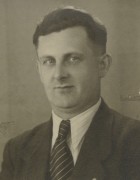
Dad continued to take food to the Guggenheimers and I went with him as often as possible. We did not realize that the elderly Jewish gentleman who lived next door to our friends was aware of our food deliveries, but obviously he was. One evening, Dad and I took our grocery bags to the Guggenheimers’ home. We placed them at their front door, rang the bell, and then stepped into our hiding place behind some bushes. No one came to the door. Dad rang the bell a second and then a third time but there was no answer. We collected the groceries, thinking that we would take them home and try again the next day.
At that moment, the gentleman from the next door came outside and walked by us close enough to slip a piece of paper into my dad’s hand. It was too dark outside to read it, but when we got home we read: “All three of your friends were taken away by the S.S. during the night.” As much as we had known it might happen, we just could not accept that a wonderful family like the Guggenheimers were taken away and punished for no other reason than being Jewish.
Mr. Guggenheimer had risked his life during the last war and had received many decorations for bravery, but now Hitler’s S.S. had taken him, his wife, and his son to some camp? After Dad, Mutti and I finished crying and praying, we decided to start leaving the food instead for the gentleman next door who had given us the information. Less than three months later, he no longer answered his doorbell. At the same time, our neighbor, Dr. Malzart, disappeared. Not one of the five of them survived; not one of them ever came home again.
The question I asked my dad many times was how it was possible for so many people to be taken away from their homes and yet no one in the neighborhood ever questioned their disappearance. It was as though they had never lived there. Dad explained that people did not want to speak out in support of a Jew since Hitler’s plan was to eliminate all Jews, and no one wanted to be different from their silent neighbors, or end up getting unfavorable attention from the government. People were doing so well in Hitler’s booming economy; why should they conceal themselves with Jews and other “undesirables” who were being taken to death camps?
The Hitler Youth leaders did not forget my absence from all their teaching sessions. They continued to come to our home to try to convince my dad that I had to go to the meetings. He continued to argue that he, as my father, should have the right to decide and have control over my activities. One day, they informed my dad that they were considering taking me away from our home and having me live in a Hitler Youth facility.
Dad was willing to make one compromise when he found out that the Nazi teachings were almost absent at athletic events run by the Hitler Youth. I had done very well at sports in school, so I was welcomed at athletic meetings. But his compromise included one condition: I could go only on days when he was able to go with me. It gave him the opportunity to make sure I would not be influenced by anything I was told or any literature I was given. After all, the Hitler youth athletic events, too, were used to make us learn about and believe in Hitler and Nazism, the alleged superiority of the Aryan race and the destruction of all Non-Aryans.
Even though I was still an outsider in school and had no friends at the sports events, I did not feel deprived. Being called all kinds of insulting names did not hurt as much has it had in the past. I knew that my dad was right. I had seen myself what the Nazis believed.
I had so many wonderful grown-ups around me that sometimes I felt like one of them. Yes, some of our relatives no longer spent time with us, because of my dad’s stand against their beliefs in the Nazis, but there were still some that stayed close to us. Outside of school my time was spent with Mom and Dad, Oma Salzmann, Uncle Ewald, and Dad’s sister Else, Uncle Hermann, Mom’s youngest brother, his wife, Dora, and their sons, Gerhard and Gunther, who were my youngest cousins. We would get together with Dad’s sister Martha and her husband Karl, and also his sister Frieda and her husband, Hans, and one of my favorite older male cousins, Horst. They lived in the city of Berlin, which was not very far from us. Less often, because of the distance, we would visit Oma and Opa Kanter, Uncle Max and his family, and Uncle Willi, the shoemaker, and Aunt Agnes.
Besides all those relatives, I spent a lot of time with my piano teacher and with her famous musician friends. Practicing and playing the piano were still my happiest times, and my teacher and her friends were still encouraging me to continue my studies. They all agreed that my future as a pianist was very bright.
Vacation time was getting close and our plans for a stay in Weissbach in Sudetengau were in their final stages, and then the day arrived. We went from Berlin to Görlitz, which was the end of the regular train line before entering the Sudentengau. We switched to the smallest, most old-fashioned train we had ever seen. Steam for the engine was created by burning wood, a bell rang all the time the train was in motion to warn humans or animals on or beside the track, and a whistle was blown every now and then. There was only one track and a single train, which traveled back and forth all day long. The closer we came to Weissbach, the end of the line, the more pronounced were the echoes of the bells and whistles from the mountains surrounding us. It was as though we had stepped back in time, maybe even into a fairyland.
Weissbach was surrounded on three sides by the Iser mountains. They were just high enough to climb in a day, and on top of each mountain there was an observation tower, built either of wood or of stone. The pile of huge rocks which also provided steps and railings made it very safe to climb to the very top. Once on top, one had a magnificent view of Czechoslovakia in the south, Germany in the north, and more mountains to the east and west.
Once we got off the train we walked about a mile along the only road, going slightly uphill until we came close to the end of it, when we spotted the farmhouse where we would spend our vacation. The owners, Mr. and Mrs. Zimmerman greeted us warmly and treated us to wonderful homemade cakes and cookies while we became acquainted with each other. Then they showed us our room and the rest of the house. The guest room was located at one end of the house with a door to the outside. If you wanted to go to the kitchen without going outdoors, you walked along an open hallway in the back of the house. Much to our surprise, two cows were kept in a room beyond ours. A window-sized opening gave them the opportunity to stick their heads out whenever we came walking along the hallway. I always stopped to talk to them, scratch their heads or caress their noses. All the sheep and goats were kept at the other end of the hallway.
Also along the hallway was located the toilet, an old-fashioned outhouse. Of course, it was much more modern; after all, it was not a separate little wooden building out in the yard, it was attached to the house and located in the back hallway. You did not have to go outside in rain or snow. The entrance to the toilet was under the cover of the hallway roof, which made it much more pleasant than having to wear boots and a raincoat and carry an umbrella when it necessary to visit.
The house was small with very little land around it. Behind the house was an area just big enough for all the chickens and geese, and behind them, steps took you down to a brook. The water came from up in the mountains and babbled all along for many, many miles. At the bottom of some steps in an area had been set up for doing laundry. Clothes lines were strung up on a grassy piece of the yard for drying the laundry. This was at the end of the house where the huge kitchen was located and where all activities took place. A small room behind it served as the Zimmermanns’ bedroom, and across the front entrance from the kitchen was a tiny living room with just enough space for two upholstered chairs and a small table.
The largest area was a carpenter’s shop, which was in a separate building from the house. Mr. Zimmerman had worked with wood all his adult life and made beautiful pieces of furniture along with many useful household items. The bees which lived in the wooden beehives he had made for them must have been the must comfortable and happy bees around; the amount of honey they supplied was more than plentiful. The meals Mrs. Zimmermann cooked for us were huge and most delicious. It was a new experience to drink milk supplied by the Zimmermans’ two cows and to eat butter and cheese created by the cow’s churned cream or aged cream.
Vegetable and potatoes were grown in the fields outside the village. Everyone in Weissbach had some fields on fairly flat land and other fields which were heading up towards the mountain, which meant their work had to be done in many different directions. The Zimmermanns owned a huge German shepherd, and he and I became friends very quickly. He had been trained in many different ways which, to us, were absolutely fascinating. Sometimes Mrs. Zimmermann would fix lunch for us and her husband as well as food for his helpers and we would take the food to them. Of course we had no idea which field to go to, but all she had to do was to show the dog a carrot, or a tomato, or a potato, and let him sniff it, and he would lead us to the field where the work was being done. At other times, we would let the dog sniff an item, which we would then place some distance from the house. When we returned to the house, the dog would be told to find the item, and he would quickly locate it and bring it to us. It was lots of fun for us.
Mutti and Dad and I walked through the adjoining villages or climbed beautiful paths to the tops of the different mountains to enjoy the sights and also the sounds of the bells and whistle as we watched the little train go back and forth. After the first few times we climbed a trail, we made sure we brought along some apples. The reindeer we observed close to the trail seemed tame enough to take the apples from us, and they did.
We picked blueberries along the trail and since they were so plentiful, we started carrying containers to fill for Mrs. Zimmermann, who used them for cooking, baking, and making jam. It was all so wonderful, it seemed too good to be true, and in a way, I guess it was. Before the end of our vacation we started going to little shops to look for souvenirs to take home to our relatives.
The greeting when we entered a shop was always “Heil Hitler,” and every salesperson proudly wore a Nazi membership badge or button. Most of the souvenirs for sale were Hitler or Nazi-oriented. It was just about impossible to find items which showed only the beauty of the area.
While on vacation, we had learned another, even more disturbing bit of information. Many Czechs had lived alongside the Germans in the Sudentenland for many generations. When Hitler had annexed the area, they all had to leave their homes and everything else they owned and migrate to the German-occupied Czechoslovakia. The German population there did not seem to mind that the Nazis had forced their neighbors to leave, anymore than our neighbors back in Berlin did not care about the Nazis treatment of the Jews. Although this discovery was very upsetting and disappointing, we had enjoyed the beauty of the area so much that we left there saying we would try and come again for our next vacation.
 My Father's Legacy