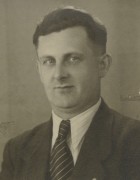
Mom, Oma Salzmann, and I started making plans for the upcoming Christmas holidays. The big question was: Would we be going to church on Christmas Eve? The decision would have to be made by Dad, and whatever he decided would be the final answer. Dad was a strong believer in God and in Jesus Christ. If he was asked why he cared so much about the Jewish people he always explained it this way: “We, being Christians, have our roots in Judaism, or are you not aware of the fact that Jesus was a Jew? The Gentiles, or unbelievers, along with many Jews alive at his time, accepted him as their Saviour, and therefore they were called Christians. You tell me to stop talking religious babble, but all I ask is for you to look into history. I know all we hear about now is Hitler’s history and the unfair treatment Germany received at Versailles after the war. How about looking back into the world’s history before Hitler? We all learned about it in school. Why do you want to ignore that past? If you don’t pay attention to the mistakes in the past, you are bound to repeat them, and you will make the same mistakes again and again.” There was hardly anyone who agreed with him, but since he had become, the Dummkopf, the dumb one in the family, why should they pay attention to him?
Before Dad made his decision about going to church on Christmas Eve, the answer came knocking at our door in the form of a pastoral assistant from the local church. At church services no collections were taken. If you wanted, you could throw a few coins into a basket near the door. The church did not need your money. A good-sized amount, called the church tax, was withheld out of every paycheck a worker received, and with that money the government supported and controlled the church. The church records included baptismal, confirmation, and marriage information, and the pastoral assistants, mostly women, were to try and get back to church those people who had not been active lately. Apparently we had been overlooked for some time, most likely because we no longer lived in Lichterfelde, the suburb where my parents had celebrated their wedding in 1927 and where I had been baptized.
About a month or so before Christmas one of the assistants from the local church came to visit. Dad was at work, so she talked with my mom and with me, telling us how much we were missing by not attending church. The talk ended up with Mom’s being asked to sign a form committing me to attendance at church school, but Mom said, “I think you need to talk to my husband about this.” The visitor asked when he would be home from work, and she returned as soon as my dad came home.
The first thing my dad noticed was the Nazi party membership she was wearing. Dad inquired about the extent of her involvement in the party, and she gave a glowing report of all the gatherings she was attending. Then the discussion turned to church school, and Dad asked questions about the church services, especially the sermons, and whether the greeting of the congregation and the end of the service still included the raised-arm Nazi salute. She answered, smiling very happily, “Oh yes, we all show our appreciation and adoration to our Führer for what he has done for Germany, and the sermons are about his life and how much we owe him.” Dad asked if any of the sermons included any scripture. She said they all did, and then explained, “Hitler set up a committee of men who took out of the Bible those passages or verses which applied to the Aryan race and in particular the German people. Those are always preached.”
Dad’s next question was about church. “Tell me, what will my daughter learn there?”
The woman answered, “She will be prepared for her confirmation; she will be taught the importance of her following the church and government rules, and many weekends she will spend at wonderful campsites where some activities will be with different groups of the Hitler Youth.” My mom and I were looking at Dad, wondering what his reaction would be. He explained that his time at home from work was limited and therefore he wanted to be able to have us spend all the time we possibly could as a family. My being involved in church school obviously would interfere with our time together. Therefore, considering the negative aspects of my becoming a member or church school, his answer had to be no. the church worker tried her best to change his mind, but he politely gave the same answer to every question she raised: No, he was not going to sign the form she had brought. She finally left after saying that if and when my dad recognized the importance of my being in involved, he should come to her office, and she would have all the necessary papers ready for him to sign. Needless to say, I never went to church school and we did not got to church on Christmas Eve.
Mom was becoming more and more nervous when our doorbell rang, think it might be the SS troopers to take away my dad. She was always worrying about him when he was at work fearing he might not come home again. Since he never hesitated to take a stand or speak his mind about Hitler’s regime, his life certainly was in danger.
Dad and I did not have as much time to spend together as we had in the past. With school hours extended, homework to complete, and piano lessons to practice, we did not have as many opportunities to just sit and talk and have him explain to me, as he used to, Hitler’s current actions. It really was something I needed badly. My thinking was being influenced by what I was taught in school and by the lessons I heard during my occasional attendance of Hitler Youth meetings. Since my dad did not allow me to become an active Hitler Youth member, I had begun to experience the same loneliness I had felt when I was considered to be a Jew because of our last name. At school, none of the groups of girls wanted to include me because I was not involved in their activities. I was an outsider. I would overhear their talk about the fun things they did on many evenings and also most weekends. I could always tell when they were going to have one of those fun evenings because they had to come to school wearing their Hitler Youth uniforms. After most weekends, I would hear about campfires and singing and swimming and sports, and I knew that I would have enjoyed every activity they mentioned. They also talked about their parents being so glad that all their children were being kept occupied because their lives were just as busy attending all the meetings the government had organized for them. It became just about impossible for me to make friends in school! Besides, my free evening and weekends gave me more time for studying, and that made it possible for me to earn the best grades in my class; this certainly did not help me become popular.
I felt so alone among my classmates, and I began to complain to my dad, asking why I couldn’t go to the meetings with them. They were having so much fun, and I did not even have any friends in school. My only friends were two girls in the neighborhood, and they were so busy all the time that I hardly saw them anymore. Dad would ask me to believe him when he said I was better off not becoming part of the groups.
There were times when I thought that, being my dad, he knew what was best for me, but at other times, I resented that I was not being allowed to make friends in school. The longer I heard about all the wonderful times they were having and watched the interaction between them, I became lonelier and more angry with Dad for not allowing me to participate. My complaints became never-ending, but even my tears did not change my dad’s decision.
On a Saturday when my dad was at home, he suggested that the two of us take a bicycle ride to Luckenwalde, because there was something he wanted me to see. He said, “I guess I have to show you why I do not want you to become part of Hitler’s plan, because I do understand that I seem to be very harsh and unfair by keeping you from being involved with your classmates’ activities.”
We left quite early and took a long ride, stopping every now and then or walking for a while. About noontime we were riding on a lovely trail through the woods. We came to an area which was surrounded with a fence of barbed wire, and Dad suggested we walk and push our bikes for a while. Within a few minutes we saw wooden barracks within the wire fence. German soldiers in uniform, with rifles hung over their shoulders and handguns on the belts along with their bayonets, were guarding people, mostly men, who were wearing striped outfits with the yellow Star of David which had “Jude” (Jew) imprinted on it. Dad told me to take a close look at the scene. Then he said to me, “Those people in the striped pajamas are prisoners, even though they have done nothing wrong. They happen to be Jewish, the same as our friends the Guggenheimers. And take a look at the train behind the barracks. See those cattle cars? Those Jewish German people are put into those cars, and then they are taken to another camp, where they are burned to death. This is what Hitler and the Nazis are doing and their ways are taught all the way down to the Hitler Youth. Do you really want to be part of an organization that teaches this is the German way? Do you want to spend time with people who think it is all right to murder our citizens because of their being Jewish? Edith, please think about it carefully.”
Dad’s co-worker, Georg Lang, had relatives living in the Sudentenland. After Hitler had annexed it, along with all of Czechoslovakia, its name was changed to Sudetengau, gau meaning a German administrative district. Georg Lang and Dad had known each other for quite some time from working together in the postal railroad cars. Georg and his wife and daughter had just spent their vacation with Georg’s aunt and uncle who lived in a tiny village at a last train stop, Weissbach, in the Iser Mountains. He told Dad all about the beauty of the village, surrounded by mountains on three sides. And happened to mention that his relatives had an extra room in their farmhouse, which had been fixed up to accommodate visitors. When Dad came home from work he told us all about his conversation with Georg and then asked us if Weissbach sounded like a place where we would like to spend our next summer vacation. Yes, it sounded as if it might turn out to be the best vacation spot we had ever gone to. Dad said he would talk to Georg, and our plans were in the making.
My dad had two brothers. The older brother was Max, and Hubert was the youngest of all the brothers and sisters. Their sister Louise had died giving birth to my cousin Franz, the guitar player, and that left Dad’s sister Frieda, Else, and Martha. Franz was adopted by his grandparents and was raised by all of them more like a brother than a nephew.
Uncle Max lived near Oma and Opa Kanter, and because of the distance we did not see him and his family very often. They had one son, Karl, and two daughters, Irma and Pauline. Along with Franz they were my oldest cousins.
A few year prior, my cousin Irma had been held back in school three times after contracting a series of childhood diseases which caused her to missed a significant portion of the school years. Every school, including Irma’s, had a miniature health department where the children’s physical as well as mental health was closely monitored. The health workers at Irma’s school, along with the principle and teachers, had come to the conclusion that Irma was retarded since she was so far behind in her studies. One day, Uncle Max and Aunt Anna received a notification that Irma had been taken to a hospital to be sterilized. Only the brightest and healthiest Aryans were allowed to procreate and Irma apparently was neither bright nor healthy. When Uncle Max inquired how the school had received permission to sterilize Irma without first obtaining her parents’ consent, he was given a copy of a government order showing that it was the school’s duty to decide which German children were mentally capable, and it was the school’s decision to determine when it was necessary for a child to undergo a sterilization procedure. It was clear from the paperwork that this was to be a government decision, not a decision made by parents. Those had been heartbreaking days for the whole family.
We had not seen Uncle Max for several years, so we were surprised and happy when Uncle Max came to visit us unexpectedly, but our happiness was short-lived when he explained what had brought him to Berlin. My cousin Pauline had been suffering from migraine headaches, and she had been going to a local doctor for treatment, which had consisted mostly of some type of injections. She seemed to improve at first but after a few months, she started having seizures. She was taken to a hospital in Berlin, and Uncle Max had just gone there to see her but was unable to get any information about her condition. He shared what he had observed and told us that the hospital showed every indication of being an asylum; he had walked away from there with the feeling that he would never see his daughter again.
My Uncle Max also shared news about my other cousins. Cousin Karl had been drafted long before the war had started and was now with Hitler’s troops in Poland. He was an experienced pilot, who first served as a pilot in Spain’s civil war, which was a real training ground for the German Air Force.
After being sterilized, Irma showed no signs of being retarded. After finishing her education, she had fallen in love with a neighbor’s son whom she had known for some time. He was involved with Hitler’s S.A. troops but he always managed to find plenty of time to spend with Irma. They had become engaged and plans had been in the making for a big wedding when the bridegroom-to-be found out that Irma had been sterilized. He explained that being in the S.A. and being a strong Hitler supporter he was not allowed to marry a woman who could not bear children. He had the orders and responsibility of supplying as many children as possible to the Reich. He stated that as much as he did love Irma, his commitment to the Führer was his priority. Irma ended up in a deep depression, as did Aunt Anna, who found it impossible to deal with all the heartaches in their family. Tears were shed by Uncle Max, and my dad and Mom and I cried right along with him. Yes, my cousins in Uncle Max’s family were much older than I was but they were a part of our family and I loved them. We sat and prayed together, and when Uncle Max was leaving we all agreed we should get together more often regardless of the distance that separated us. Dad and Mom wrote a note to Aunt Anna and Irma, and Uncle Max gave me Karl’s address so that I could write to him, since the soldiers who were away from home always waited to hear from the folks they had left behind.

